On a spring day in 1373, a thirty-year-old woman lay at the point of death in her home city of Norwich. When she recovered days later, she carried with her sixteen visions that would change English literature forever.
Born circa 1343 and living her entire life in Norwich, Julian anchored herself in a small cell attached to St Julian's Church in Conisford, dedicating herself to contemplation and writing. The result was Revelations of Divine Love (also known as Showings), the earliest surviving book in English written by a woman; a remarkable achievement that has earned her recognition as a foundational figure in English literary history.
The Visions of May 1373
Julian's visions came during a severe illness between 8 and 13 May 1373. She received sixteen "showings" over the course of five days, beginning with a vision of Christ on the cross that filled her with the certainty of divine love. These revelations occurred against a backdrop of profound hardship; Norwich had endured the Black Death of 1348 to 1350, which killed more than half the population, and the city would soon witness the Peasants' Revolt of 1381.
In her writing, Julian described the experience with striking physical detail: "He showed me a little thing, the quantity of a hazelnut... It is all that is made." This image of the hazelnut, symbolising the fragility and preciousness of creation, has become one of the most enduring images in English mystical literature.
The Anchorhold at St Julian's
Following her visions, Julian chose the life of an anchoress, committing herself to permanent enclosure in a cell attached to St Julian's Church. The church, located in the Conisford area of Norwich, originally dedicated to St Julian of Le Mans or Julian the Hospitaller, provided a foundation for her spiritual practice.
The anchorhold contained three windows: one opening into the church to view Mass, one for receiving food and necessities, and one for visitors seeking spiritual counsel. Historical wills from the period mention servants attending to Julian, including Sarah and Alice, referenced in the 1404 will of Thomas Edmund, a chantry priest from Aylsham.
The anchoress tradition followed guidelines from texts such as Ancrene Wisse, a rulebook written circa 1200 that instructed female recluses in prayer, daily conduct, and the management of their cells. Julian's cell was demolished during the Reformation in the 1530s, but a modern shrine now marks the site.
The Two Texts of Revelations of Divine Love
Julian composed two versions of her work. The Short Text, written circa 1373, runs to approximately thirty-three pages and survives in British Library Additional MS 37790. The Long Text, a more elaborate expansion of eighty-six chapters and roughly 63,500 words, was composed between the 1390s and 1410s.
Her work remained in manuscript until 1670, when it was published by Serenus de Cressy under the title XVI Revelations of Divine Love. The modern revival of interest in Julian began with Grace Warrack's 1901 edition, which introduced her writing to twentieth-century readers and established her place in the canon of English literature.
"All Shall Be Well": Julian's Enduring Message
Julian's most famous passage appears in Chapter 27: "All shall be well, and all shall be well, and all manner of thing shall be well." This declaration of divine optimism emerged from a period of intense suffering; both personal and communal. She wrote of sin as "behovely" (necessary) within God's larger design, a theological position that continues to generate scholarly discussion.
Her closing chapter contains another celebrated passage: "Love was His meaning... Hold fast to this and you shall know and understand love more and more." This emphasis on love as the central truth of existence distinguishes Julian's work from the more punitive theological writing common in her era.
Historical Documentation
Julian's existence is confirmed through several contemporary wills. On 20 March 1394, Roger Reed, rector of St Michael Coslany, made a bequest to "Julian anakorite." Thomas Edmund's will of 19 May 1404 left provision to "Julian, anchoress of St Julian's, Conisford." Further references appear in the wills of John Plumpton (1415) and Isabelle, Countess of Suffolk (26 September 1416), the latter describing her as "Julian reclus a Norwich." These documents place her death sometime after September 1416.
The medieval mystic Margery Kempe, author of the first autobiography in English, visited Julian circa 1413 to 1414 for spiritual counsel, recording the meeting in her own writings.
St Julian's Church: From Destruction to Renewal
The church that anchored Julian's life has its own remarkable history. Built in the eleventh and twelfth centuries on a site destroyed by Viking raids in 1004, it operated under the authority of Carrow Abbey from 1135. The medieval bell, cast in 1450 by Richard Brayser, was rehung in 1992 and continues to ring today.
During the Norwich Blitz on 27 June 1942, St Julian's Church was destroyed by bombing. It was rebuilt and reopened in 1953, maintaining its Grade I listed status and distinctive round tower of flint construction.
Modern Recognition and Heritage
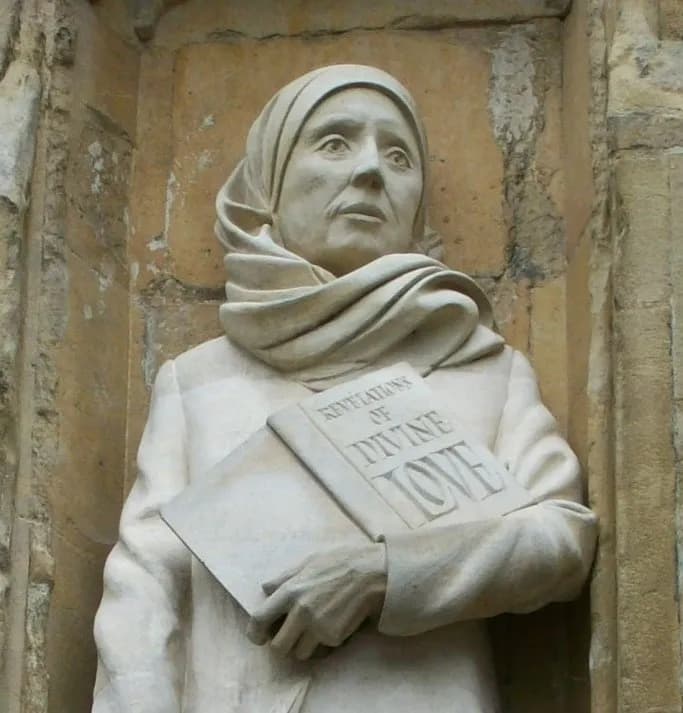
Julian's significance to Norwich is now commemorated in multiple ways. A statue by sculptor David Holgate was installed on the west front of Norwich Cathedral in 2000, depicting her holding a book. The Friends of Julian of Norwich, a registered charity, maintains the Julian Centre at St Julian's Church, which remains open daily for prayer and welcomes visitors to the shrine marking her cell's location.
The annual Julian Lecture, reaching its forty-fifth iteration in 2026 with the theme "Julian's Sensory World: Embodied Knowledge in Medieval Norwich," demonstrates continuing academic interest. Her words featured prominently at the installation of the 106th Archbishop of Canterbury in 2026, and composer Joanna Marsh created an anthem titled "All Shall Be Well" inspired by her writings.
The Julian 650 celebrations in 2023 marked the 650th anniversary of her revelations, drawing pilgrims and scholars to Norwich to honour the woman who transformed personal visions into a lasting contribution to English letters.
Norwich's Medieval Spiritual Landscape
Julian's work emerged from a city with an exceptional religious character. In the fourteenth century, Norwich was England's second largest city with a population of approximately 25,000. It supported five monasteries, the cathedral, and an unusually high number of anchorites and hermits for a town of its size. The Lollards' Pit, near St Julian's Church, served as an execution site for religious dissenters, a reminder of the theological tensions that characterised Julian's era.
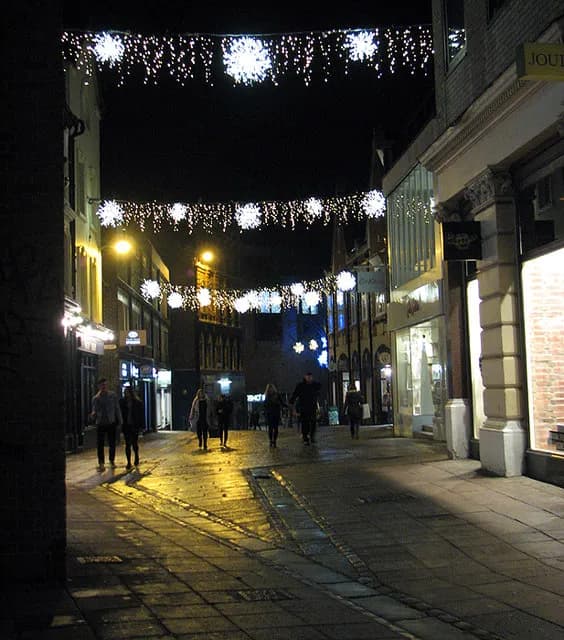
Today, visitors to Norwich can walk the path Julian would have known, from the narrow lanes of Conisford to the round tower of her church, connecting with a literary heritage that began with a woman who chose enclosure and, through her writing, achieved a voice that has resonated across six centuries.