Norwich Cathedral houses one of the most extensive collections of surviving medieval roof bosses in England. These intricately carved, painted, and gilded stone and timber bosses, numbering more than a thousand across the nave, choir, transepts, and cloisters, form a remarkable visual chronicle of biblical narrative, local folklore, and medieval craftsmanship.
From Timber to Stone: The 15th-Century Vaulting
The cathedral was founded in 1096 by Herbert de Losinga, Norwich's first bishop. The nave was completed by around 1120 and the entire building by 1145. For its first three centuries, the interior was crowned with flat timber ceilings. In the 15th century, these were replaced with stone vaults throughout the building.
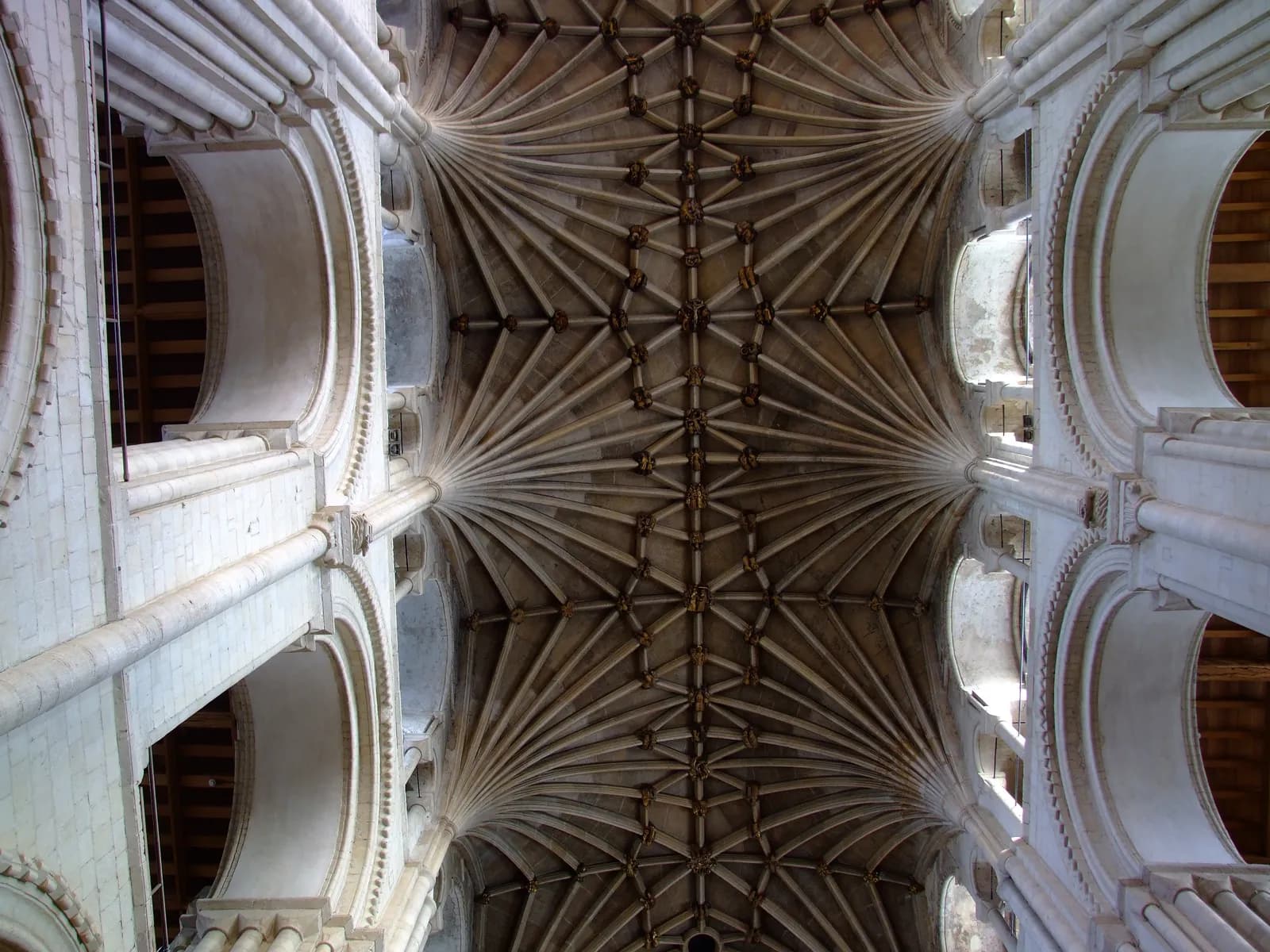
The nave was vaulted under Bishop Walter Hart, who held the see from 1446 to 1472. His successor, Bishop James Goldwell (1472–1499), oversaw the vaulting of the choir and the Bauchun Chapel. The transepts received their stone ceilings after 1520. The resulting architecture is a tierceron vault with lierne ribs that form elaborate patterns of lozenges and stars across the ceiling.
Biblical Stories Carved in Stone
The nave vault presents a sequential narrative depicting the history of the world from creation. Visitors who look up can trace the biblical story across the ceiling, with individual bosses marking key moments in scripture. The carvings are not merely decorative; they served as a visual bible in an age when literacy was not universal.
The cloisters, which are the second largest in England and were built between 1297 and 1430, contain nearly 400 carved stone ceiling bosses. The east walk features foliage alongside scenes from the Passion of Jesus. The north walk depicts the Resurrection and episodes from the life of Mary. The south and west walks carry imagery of the Apocalypse, the Annunciation, and Herod's Feast.
Green Men, Mythical Beasts, and Hunting Scenes
Among the religious subjects are figures drawn from medieval English folklore. Early bosses favour flowers and foliage, while later examples introduce foliate heads, acrobats, mythical animals, and hunting scenes. These carvings offer a glimpse into the beliefs, humour, and popular culture of medieval Norwich, a city whose cathedral close alone once occupied a tenth of the total urban area.
The bosses are carved from stone and finished with paint and gilding that, in many cases, has survived the centuries. Art historians regard the collection as one of the world's great medieval sculptural treasures.
Surviving Iconoclasm
Norwich Cathedral suffered damage during the riots of 1272, and its wooden spires were lost to storms and fire in 1362 and 1463. The building was extensively remodelled in the 19th century, notably by architect Anthony Salvin in the south transept. A new Lady Chapel was added between 1930 and 1932, and a new hostry designed by Hopkins Architects opened in 2010.
Despite these changes and the widespread destruction of medieval imagery during the Reformation, the roof bosses survived largely intact. Their high position above the congregation may have protected them from the iconoclasm that stripped many English churches of their medieval art.
Viewing the Bosses Today
The cathedral is a Grade I listed building and forms part of the "Norwich 12," the city's collection of most iconic structures. Visitors can explore the interior during regular opening hours, and a virtual tour is available through the cathedral's official website. The height of the vaulting means that binoculars or a good zoom lens are helpful for examining individual bosses in detail.
In July 2019, the cathedral installed a 17-metre helter-skelter inside the nave specifically to give visitors a closer view of the roof bosses. The initiative attracted national attention and underscored the enduring public fascination with this overhead gallery of medieval storytelling.