Edith Louisa Cavell was born on 4 December 1865 at Cavell House, a Georgian farmhouse in Swardeston, a village four miles south of Norwich. The daughter of Reverend Frederick Cavell, who served as vicar of Swardeston for 45 years, and his wife Louisa Sophia Warming, she would become one of the most celebrated figures of the First World War. Her execution by German firing squad in October 1915 sparked international outrage and ensured her name would be remembered far beyond the Norfolk parish where she spent her childhood.
Early Life in Norfolk
Edith Cavell's early years were shaped by the rhythms of rural Norfolk life and the strong Anglican faith of her family. She was the eldest of four children, with two sisters and a brother. The family lived at The Vicarage in Swardeston, which Frederick Cavell had built in 1865 at his own expense, standing next to St Mary the Virgin Church where he ministered.
Her education began locally, and in 1881 she attended Norwich High School for Girls when it was housed at the Assembly House in Theatre Street. She walked to school each day, dropping her brother Jack at Miss Brewer's school in Lime Tree Road along the way. She later attended boarding schools in Clevedon, Somerset, and Laurel Court in Peterborough, where she was confirmed on 15 March 1884.
The Path to Nursing
Cavell did not begin her nursing career until she was 30 years old. In December 1895, she started her training at Fountain Fever Hospital in Tooting, London. A year later, she moved to The London Hospital, where she trained under the renowned Matron Eva Luckes, a disciple of Florence Nightingale.
Her dedication was quickly recognised. During the Maidstone typhoid epidemic of 1897 to 1898, she was awarded the Maidstone Typhoid Medal for her service. Over the following years, she held positions as Night Superintendent at St Pancras Infirmary and Assistant Matron at St Leonard's Infirmary in Shoreditch. By 1906, she had become Matron of the Manchester and Salford Sick and Poor and Private Nursing Institution.
Nursing Pioneer in Brussels
In 1907, Dr Antoine Depage recruited Cavell to become matron of L'École Belge d'Infirmières Diplômées at the Berkendael Medical Institute in Ixelles, Brussels. Her task was to modernise nursing in Belgium along Nightingale principles. By 1910, she had launched a nursing journal called L'infirmière and was training nurses for three hospitals, 24 schools, and 13 kindergartens across Belgium.
When war broke out in August 1914, Cavell had been visiting her mother in Norfolk. She returned immediately to Brussels, where the Red Cross took over her clinic and nursing school. As German forces occupied Belgium, Cavell found herself treating wounded soldiers from both sides.
The Escape Network
From November 1914, Cavell became involved in a clandestine operation to shelter British soldiers and funnel them out of occupied Belgium to the neutral Netherlands. Over the course of several months, she helped approximately 200 Allied soldiers escape. Her actions were discovered, and on 6 August 1915, she was arrested and imprisoned at Saint-Gilles prison in Brussels.
She was court-martialled alongside 33 others, charged with harbouring Allied soldiers and conveying troops to the enemy under German military law. Cavell admitted her guilt. The court sentenced her to death by firing squad.
Final Words and Execution
On the evening before her execution, 11 October 1915, Cavell met with Reverend H. Stirling Gahan. Her final words to him have become among the most quoted of the war: "I am thankful to have had these ten weeks of quiet to get ready. Now I have had them and have been kindly treated here. I expected my sentence and I believe it was just. Standing as I do in view of God and Eternity, I realise that patriotism is not enough, I must have no hatred or bitterness towards anyone."
She was executed at 7:00 am on 12 October 1915 at the Tir national shooting range in Schaerbeek, Brussels. She was 49 years old.
Return to Norwich
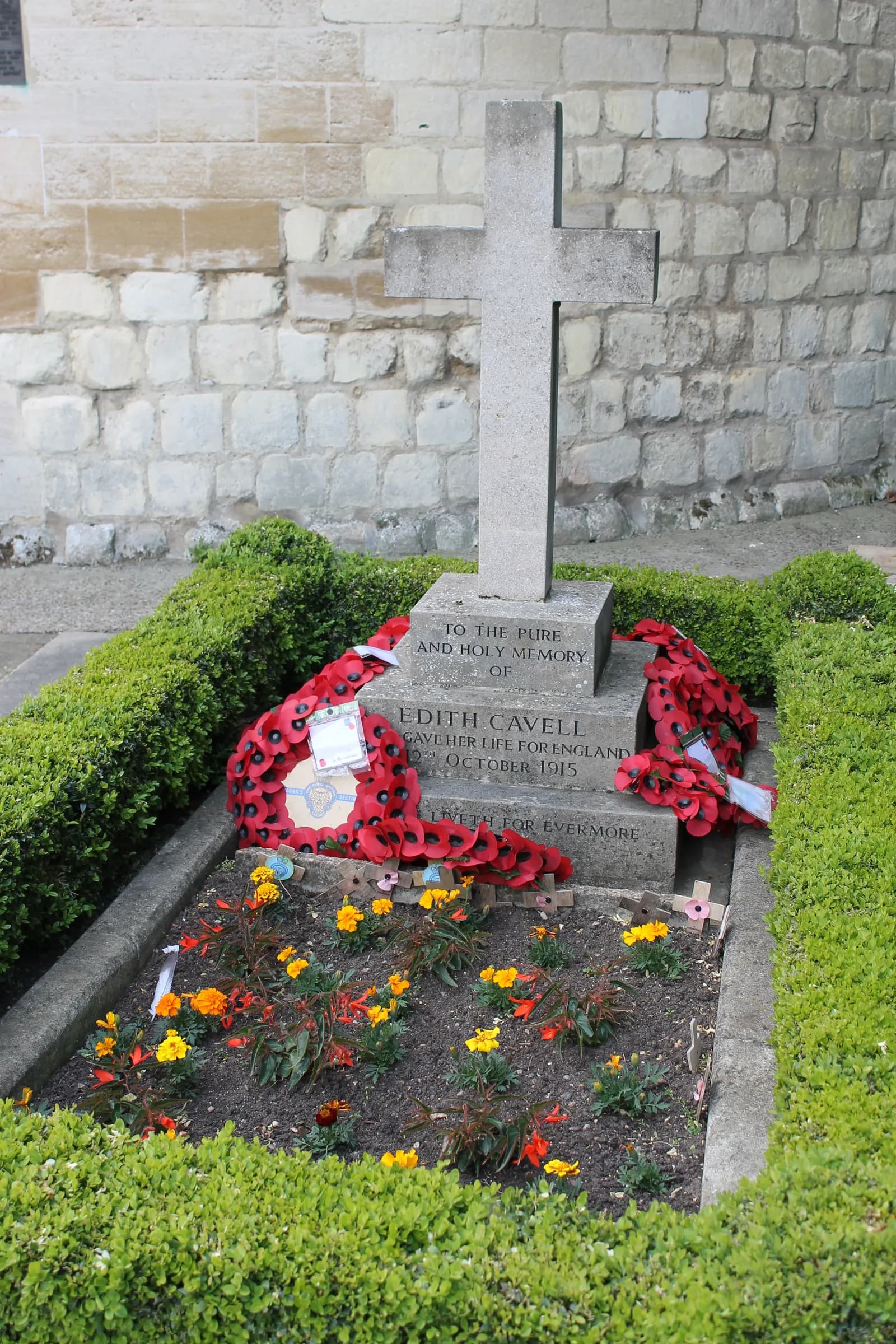
Following the war, Cavell's remains were repatriated to Britain. They sailed from Ostend aboard HMS Rowena on 14 May 1919, landing at Dover. After a state funeral at Westminster Abbey on 15 May, she was buried on 19 May 1919 at Life's Green on the east side of Norwich Cathedral. The burial required special permission from the King to bypass an Order in Council of 1854 that had prevented burials in cathedral grounds.
Her grave remains well-tended and is nearly always covered in flowers. An annual graveside service is held each October to commemorate her.
Memorials in Norwich
Cavell's connection to Norwich endures through numerous memorials. At Norwich Cathedral, a statue by Henry Alfred Pegram was unveiled by Queen Alexandra in 1918 during the opening of a nurses' home named in her honour. St Mary the Virgin Church in Swardeston contains her portrait and an East Window memorial installed in 1917. The church also preserves a shaft of the wooden cross from her first grave at Tir national.
Across Norwich, her name lives on in Cavell Primary School, Cavell Road, and The Edith Cavell public house in Tombland. The University of East Anglia's Edith Cavell Building houses the School of Nursing Science, continuing her legacy in nurse education.
The Cavell Room at Swardeston Church and the biennial flower festival held nearest to 12 October ensure her memory remains part of the community where her story began.